

Hi everyone,
I want to introduce my friend MarketFighter, an excellent investor who has consistently beaten the market. He explains his simple ETF strategy below. If you want your portfolio to grow as fast as his, subscribe to his publication.
Thanks for having me here, Denis!
I like your take on the markets, and while we agree on most things, our philosophies are somewhat different. My core perspective on investing is:
Why try to predict the next trends when you can utilize the market patterns that have worked consistently for decades?
Let me quickly introduce myself to your readers:
I’m a 41-year-old software engineer and family man living in Denmark. Earlier this year, I quit my job to live off my investment strategy.
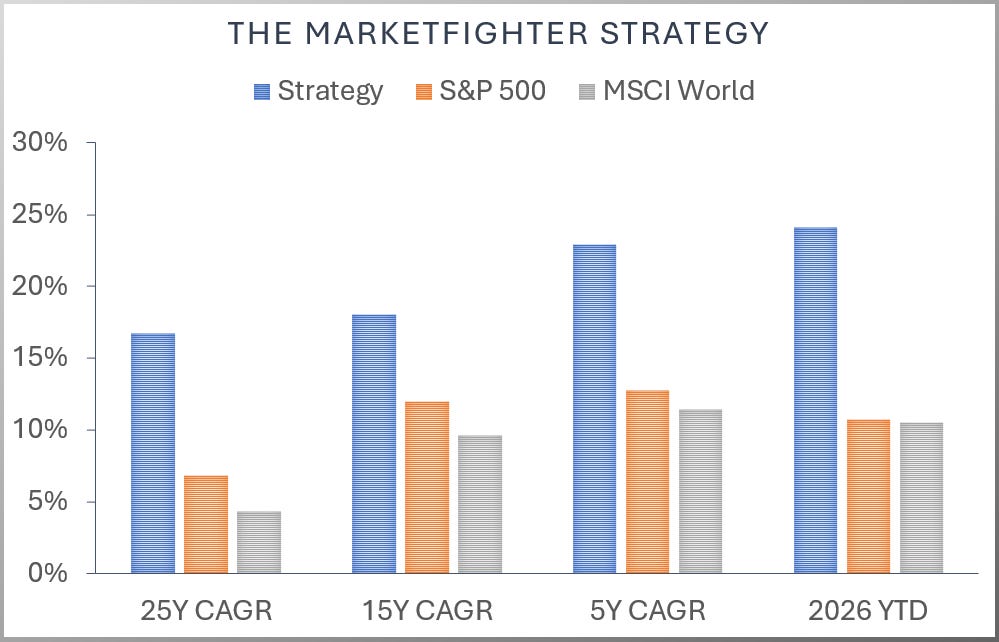
Like many engineers, I’m obsessed with logic and processes. In early 2021, I built a simple rules-based ETF system. It has beaten the S&P 500 in 22 of the last 26 years, including the last five years during which I’ve traded it myself.
My returns from this approach have given me a lot of freedom and flexibility to live my life on my own terms. Now I share the full strategy with subscribers to The MarketFighter Strategy on Substack.
In this post I will give you a quick introduction to my approach, how it allowed me to quit my job, and my learnings from 22 years of investing.
How did I end up here?
I started investing a small amount of money when I was 18. Nobody I knew did this, but I got completely hooked by the idea of beating the market and eventually living off market returns. However, in the beginning I had no idea what I was doing…
Luckily, I only traded small amounts back then, because it didn’t work very well. But the passion was sparked, and over the years I read a ton of books and articles about investing. I’ve investigated almost every possible strategy out there.
The vast majority of people underperform the market in the long run. Even highly paid professionals and Wall Street veterans.
I knew that my only chance of succeeding would be to look beyond the traditional approach of macro analysis, earnings deep dives and trying to estimate the fair value of companies.
If you want a different outcome, start with a different process.
This is what I found
Eventually, my background as a software engineer helped me see the market from a different angle. 15 years of my own research can be boiled down to these five bullets:
Stock picking is extremely hard
We all have ideas of which companies we believe have a bright future. But research shows that even the best 80-hours-a-week analysts from Wall Street are rarely able to beat the market. The median stock has a negative lifetime return, but we expect “market” returns or better.Predicting is impossible
Luck and randomness play a much bigger role in markets than we anticipate. No one can predict the markets, regardless of how deep their research is. There’s no getting rich quick, unless it’s from extreme luck.Index investing is boring
For a while, years ago, I switched to index investing due to the findings listed above. It beats almost every stock picker in the long run, but I found it boring and unsatisfying, and I was eager to beat the index.There are patterns in the market
There’s a lot of research available on what has historically and (somewhat) consistently worked in the markets. Simple recipes for excess returns, like momentum, value, quality and size factors.A rules-based system can beat the index
Most of the big winners in the markets are those who follow a systematic approach. This avoids human bias and emotion-driven decisions. Instead it builds on what has been proven to work in the markets.
With all of these revelations, I started building my own system in early 2021. I wanted something that was simple to follow, not too risky, and as consistent as possible while still outperforming the market in the long run.
A system to beat human opinion
Before I dig into how the system works, let me show you how it has performed since I started trading it in March 2021:
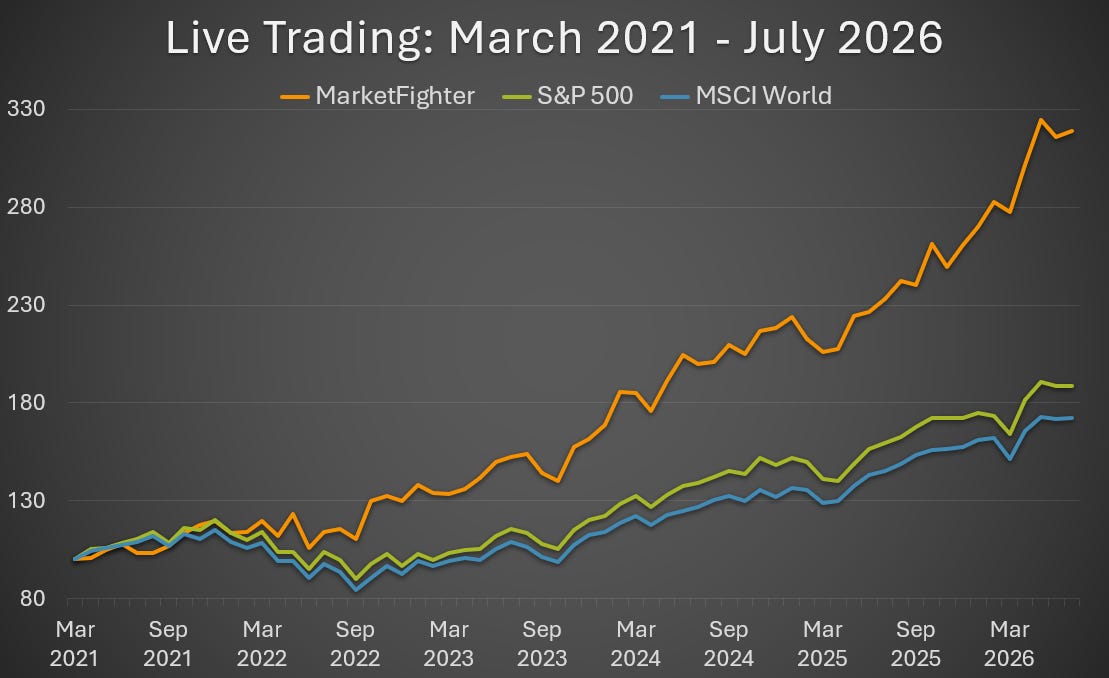
As you can see, it has significantly outperformed both the S&P 500 and the MSCI World Index. Backtesting shows similar performance back to 2000.
Here’s how I do it
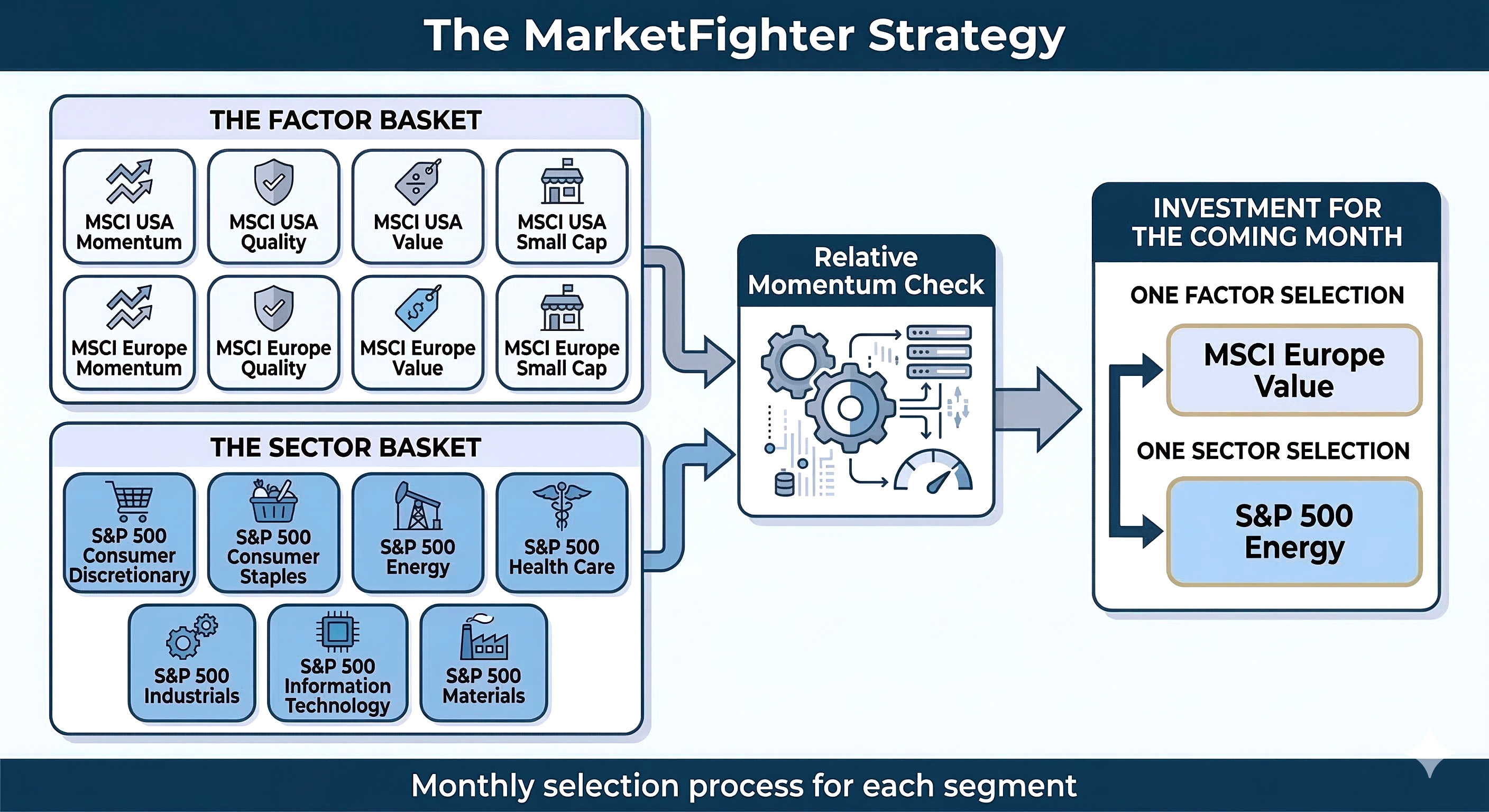
I have a predefined basket of 8 factor ETFs. These are widely available ETFs focused on either Momentum, Quality, Value or Size. For each of them, I use one for US stocks and one for European stocks, amounting to 8 in total.
Similarly, I have a basket of 7 sector ETFs. These are the 7 US sectors with the best historical returns and the most consistency.
At the end of every month, my system picks the best ETF from each basket. One factor ETF and one sector ETF. It holds these two positions at a 50/50 weight until the month ends. No trading in between no matter what happens.
How it picks the strongest ETFs
It’s entirely rules-based. This avoids bias, opinions, or emotion-driven decisions from my side. It relies on relative price momentum. This means it picks the asset that performed the best over certain intervals.
Why does this work? The momentum effect in markets was academically proven and published in the 1990s and it’s everywhere in the markets once you start looking for it. I got the idea of applying it across two baskets from Gary Antonacci’s book Dual Momentum Trading.
Why sectors and factors? Sector rotation strategies are a common and simple way to outperform the market, if you have the discipline to follow them.
Factors basically cover patterns for outperformance. The four mentioned factors have all outperformed the market if you look at long enough time horizons. The problem is they also have long phases of underperformance.
This is where relative momentum kicks in. It rides the best factors and sectors while they’re growing, and rotates out of them when they don’t.
Results and backtesting
After 15 years of research and lots of failed attempts, I realized in early 2021 that I was getting close to something that could turn out really great.
By putting all the elements together into a 100% rules-based system, I was able to backtest it. Backtesting means you apply the same rules on historical market data to see how a strategy would have performed back in time.
The table below shows the backtested results (2000-2020) as well as the continued performance since I started trading it (from March 2021). This time I compare with the MSCI World Index:
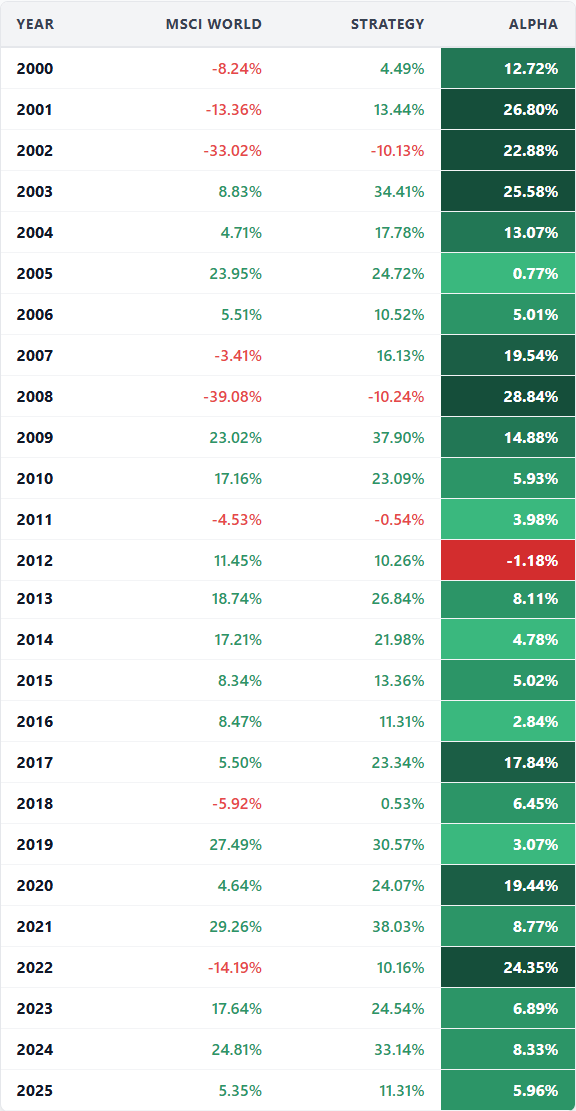
The numbers are measured from the perspective of a EUR-based investor, and not accounting for trading fees. So far, it has outperformed the MSCI World Index in 25 of the last 26 years, currently on track to add one more. As mentioned earlier, it also beat the S&P 500 in 22 of those years.
The new life investing has given me
You should always be skeptical of backtested results. But after five years of trading this with my own money, it became life-changing.
I quit my job as a software developer earlier this year. My portfolio had grown significantly, and I just wanted to pursue my passion for investing and strategic thinking. I wanted to be my own boss.
That’s when I started to share my strategy on Substack. Until then, only my family and a few close friends knew about it.
Once a month, before the markets open on the first trading day, I send out the trading signal my system generates. This reveals the two selected ETFs I will be holding for the coming month. Execution takes 15 minutes.
I strongly believe in transparency and open communication, which is why I share complete performance updates in public every month.
I’m blown away by the level of support and feedback I have received, and the number of subscribers joining every day is beyond my wildest expectations.
Honestly, I don’t miss going to work. I’m deeply grateful for the freedom and the life investing has given me.
If you found this post interesting and want to learn more, feel free to join our growing community at The MarketFighter Strategy.
Thanks for reading!
Disclaimer: The MarketFighter Strategy is for educational and informational purposes only. It is not financial advice, and the author is not a licensed investment advisor. Investing in ETFs involves significant risk, and past performance is never a guarantee of future results. You are solely responsible for your own trades and financial outcomes.
Subscribe to The MarketFighter Strategy
Join the simple ETF strategy that outperformed the S&P 500 in 22 of the last 26 years. High consistency in just 15 minutes a month. Based on evidence and rules, not opinions.

Very interesting, thanks! How does the strategy look on an after tax basis? By jumping in and out of positions monthly, all your gains will be short-term, won’t they? This matters materially for a U.S. investor, at least when compared to the boring index strategy. (Which, although unsexy, reliably beats 90% of all other strategies.)
Fantastic